How to Read the Circles for Stats in No Man's Sky
 | The discipline of this article is from the Frontiers update. The data from this article is up-to-date as of 15 February, 2022. |
The subject area of this article is from the Frontiers update.
The information from this article is up-to-date as of 15 February, 2022.
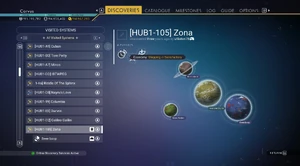
HUB1-105 Zona
A star organisation is a system of planets and other objects that orbit a star.
Contents
- one Summary
- ii Data on Milky way Map
- 3 Nomenclature
- three.1 Number of Stars
- 3.2 Influence on Planet Generation
- 3.3 Other classifications
- 4 Classification Exceptions
- 5 Gateway systems
- six Concentration of star systems
- 7 Naming conventions
- eight Space Encounters
- 9 Known star systems
- ten Known star systems (pre-release)
- xi Additional Information
- 12 Release history
- 13 Gallery
Summary [ ]
These procedurally generated systems are the seat of all planets and worlds in the game. Most of the planetary systems in No Human being'southward Sky will never exist visited.
They are also known as solar systems or planetary systems.
Information on Galaxy Map [ ]
The UI for the Galactic Map shows key information regarding the system selected. The Information that is displayed is:
- Star organization proper noun
- Spectral class
- Presence of planets with seas or oceans (Water)
- The region the organisation ID is part of
- Dominant Lifeform
- Economy (Requires Economy Scanner)
- Disharmonize Level (Requires Disharmonize Scanner)
- Distance from the Galaxy Centre
- Based on camera position. If clicked based on the circle around the system.
- Geometry is needed to calculate the bodily distance in the eye of the circle every bit washed by No Man'southward Sky in its initial iterations.
Classification [ ]
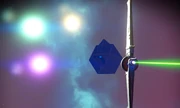
Irangbi Half-dozen, a Ternary Star System.
There are four colours of star systems.
- Yellow star systems (Classes F & G) are the well-nigh common.
- Blood-red and orange star systems (Classes One thousand & G), uncommon, tin only be accessed with Cadmium Bulldoze, only Cerise/Orangish star systems will have planets with Cadmium.
- Green star systems (Class E, invented class), rare, can only be accessed with Emeril Drive, only Green star systems volition have planets with Emeril.
- Bluish and purple star systems (Classes B & O), rare, can only be accessed with Indium Drive, but Blue/Royal star systems will have planets with Indium.
Number of Stars [ ]
At that place are iii possibilities for the number of stars in a system:
- Unmarried-Star systems merely have one star (virtually common).
- Binary Systems have ii stars. Each star could be a unlike colour.
- Ternary Systems have three stars. Each star could exist a dissimilar color.
There are systems then close to each other (<= 2 ly) that they would allocate equally a binary or at least a double star organization. Even though their proximity should brand them visible, they were not reflected in the skyboxes ingame. Examples of this phenomenon are Olenwag and Houdat. Ii lightyears hereby refers to the realistic distance the gravitational pull of a small sunday tin can reach based on its Colina sphere.
Influence on Planet Generation [ ]
Planet Generation parameters are influenced by star system types, likewise as galaxy types (see Biome Probabilities). However, galaxy types only alter yellow star systems, therefore red, greenish, and blue stars have similar parameters beyond all galaxies.
- The odds for exotic biomes, in any galaxy, are: Red (x3) > Dark-green (x1) < Blue (x2). In Imperfect and Raging galaxies, yellow stars volition rarely take exotic planets. In Bequeathed galaxies, yellowish stars have the aforementioned chance for exotic planets every bit dark-green and bluish stars.
- In Normal and Harsh galaxies, xanthous stars have 2x more gamble to have lush planets.
- In Lush galaxies, yellow stars have 4x more than chance to accept lush planets, and 4x lower chance to have dead planets, compared to other stars in that milky way.
- In Empty galaxies, yellow stars have 2x more chance to take expressionless planets, and lush planets accept the same chance as other stars in that milky way.
Other classifications [ ]
Uncharted star systems and abandoned star systems are systems devoid of sentient life. Uncharted systems are empty of any structures, including infinite stations, and abandoned systems only take ruins and abased structures, and volition non take any fauna life.
The tables beneath evidence the chances for abased and uncharted systems per star colour:
- Abandoned systems
| Yellow | Red | Light-green | Blue |
|---|---|---|---|
| 0 | 0 | 0.1 | 0.1 |
- Uncharted systems
| Xanthous | Red | Green | Blue |
|---|---|---|---|
| 0 | 0.95 | 0.four | 0.4 |
Noteworthy, all abased and uncharted systems were inhabited before the overhaul of their generation in NEXT and take been wiped out artificially, effectively constituting the starting time documented genocide of No Man'due south Sky and the Atlas.
Classification Exceptions [ ]
Certain types of star systems cannot be distinguishable based solely on their colour or spectral course. This includes star systems containing:
- Atlas Interfaces (systemid = 122)
- Black Holes (systemid = 121)
Without a quest or ability to guide the player, both the Atlas Station and the Black Hole tin exist institute by help of a portal. In one case visited it can be tracked down past selecting the system from the discovery menu as waypoint after returning home.
Atlas Station: 07A
Black Pigsty System: 079
Gateway systems [ ]
Gateway systems are special systems that can be found near the Milky way Centre. The player tin can but bound into the centre from a gateway system, which requires a starship with a fully charged Hyperdrive.
Each galaxy has several gateway systems and these can be located on the Galactic Map by choosing the Galactic Core as the destination. The player will be directed to the nearest ane on their path to the cadre.
Each galaxy page contains a list of documented gateway systems.
Concentration of star systems [ ]
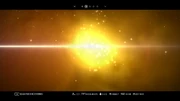
A concentration of star systems.
It is possible to find a concentration of star systems in the galaxy. Those concentrations are extremely rare and have a colourful blur. It is unknown if those stars are any different from the standard. Multiple blue, ruby-red, and dark-green stars can be found in these.
Naming conventions [ ]
All star systems receive a random name from the initial seed. When discovered, they may exist renamed by the discoverer. At that place are a variety of Star System Nomenclature options for choosing a star name, or random names may be chosen at will.
As with planetary discoveries, players are limited to 42 characters when renaming a star system.
Space Encounters [ ]
The classification of star systems influences which space encounters tin trigger when using the pulse drive of your starship within a organization.
Known star systems [ ]
For a listing of known star systems, see the star system category.
Known star systems (pre-release) [ ]
For a list of known pre-release star systems, see the Pre-release star organization category.
Boosted Information [ ]
- Abandoned and Uncharted organisation probabilities extracted from the 3.75 version of the GCSOLARGENERATIONGLOBALS.GLOBAL.MBIN game file.
Release history [ ]
- Atlas Rises - the alphabetic character and number part of a star's classification were temporarily removed. It was restored as part of Update i.38, merely without Blackness Holes. Atlas Stations and Blackness Holes at present show the spectral class of their bodily star.
- NEXT - the warp bulldoze classifications changed, replacing Sigma/Ruby-red, Tau/Green, and Theta/Blueish
- Abyss - Systems with body of water worlds are now indicated with "H2o" subsequently the star classification.
- Origins - Binary and ternary systems are added to the game, biome probabilities changed.
- Prisms - Sky look has changed, more than stars are at present visible.
Gallery [ ]
-

Star sytem view
NEXT -

Sky view
Prisms -

Milky way Map Explanation from NMSResources
Source: https://nomanssky.fandom.com/wiki/Star_system
0 Response to "How to Read the Circles for Stats in No Man's Sky"
Post a Comment