what wood did the romans use to crucify
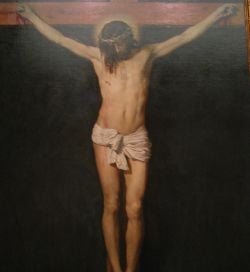
Crucifixion was an ancient method of execution practiced in the Roman Empire and neighboring Mediterranean cultures, such as the Persian Empire, where a person was nailed to a large wooden cross or stake and left to hang until dead. Opposite to popular conventionalities, those crucified did not die through loss of blood but through asphyxiation equally they could no longer concord themselves upwards to breathe.
The purpose of crucifixion was to provide a gruesome public way to execute criminals and dissenters so that the masses would be dissuaded from breaking the law. In the Roman Empire, crucifixions were usually carried out in public areas, specially nigh roads such as the Appian Mode, where many would walk by to view the frightening power of the state.
Contents
- ane Etymology
- 2 History of crucifixion
- two.1 Pre-Roman States
- two.2 Roman Empire
- 2.3 Modern times
- 3 Controversies
- 3.ane Cross shape
- 3.two Location of the nails
- 3.three Crusade of death
- 3.4 Archaeological evidence
- 4 Other Details
- 5 Famous crucifixions
- 6 Crucifixion in popular culture
- seven Notes
- viii References
- 9 External links
- ten Credits
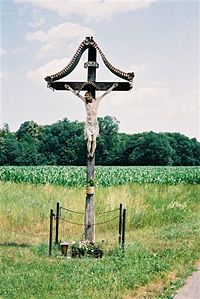
The most famous crucifixion in history is undoubtedly Jesus of Nazareth who was killed by the Romans for allegedly claiming to be the "King of the Jews," which ostensibly challenged the Roman Emperor'southward power and hegemony. Today, the nearly distinctive symbol of Roman Catholicism is the crucifix (an image of Christ crucified on a cross), while Protestant Christians unremarkably prefer to apply a cross without the figure (the "corpus" - Latin for "trunk") of Christ.
Etymology
The term "crucifixion" derives from the Belatedly Latin crucifixionem (nominative crucifixio), noun of action from past-participle stem of crucifigere "to spike to a cross." [1]
In Latin, a "crucifixion" applied to many different forms of painful execution, from impaling on a stake to affixing to a tree, to an upright pole (what some telephone call a crux simplex) or to a combination of an upright (in Latin, stipes) and a crossbeam (in Latin, patibulum).[ii]
Crucifixion was usually performed to provide a death that was particularly painful (hence the term excruciating, literally "out of crucifying"), gruesome (hence dissuading against the crimes punishable past it) and public, using whatever means were most expedient for that goal.
History of crucifixion
Pre-Roman States
Punishment by crucifixion was widely employed in ancient times, when it was considered one of the most brutal and shameful modes of death.[3] It was used systematically used by the Persians in the 6th century B.C.East.:
The first recorded instances of crucifixion are plant in Persia, where it was believed that since the world was sacred, the burying of the trunk of a notorious criminal would desecrate the basis. The birds above and the dogs below would dispose of the remains.[4] It was virtually never used in pre-Hellenic Greece.
Alexander the Great brought it to the eastern Mediterranean countries in the fourth century B.C.East., and the Phoenicians introduced it to Rome in the third century B.C.E. He is reputed to have executed 2000 survivors from his siege of the Phoenician city of Tyre, too every bit the doctor who unsuccessfully treated Alexander'due south friend Hephaestion. Some historians have also conjectured that Alexander crucified Callisthenes, his official historian and biographer, for objecting to Alexander's adoption of the Persian ceremony of regal adoration.
In Carthage, crucifixion was an established manner of execution, which could even be imposed on a general for suffering a major defeat.
Roman Empire
According to some, the custom of crucifixion in Ancient Rome may have developed out of a primitive custom of arbori suspendere, hanging on an arbor infelix (unfortunate tree) defended to the gods of the nether world. Notwithstanding, the ideathat this punishment involved any class of hanging or was annihilation other than flogging to death, and the claim that the "arbor infelix" was dedicated to particular gods, was convincingly refuted.[5]
Tertullian mentions a commencement-century C.Due east. case in which copse were used for crucifixion,[6] However, Seneca the Younger earlier used the phrase infelix lignum (unfortunate wood) for the transom ("patibulum") or the whole cross.[7] According to others, the Romans appear to accept learned of crucifixion from the Phoenicians in the third century B.C.E. [3]
Crucifixion was used for slaves, rebels, pirates and especially-despised enemies and criminals. Therefore crucifixion was considered a most shameful and disgraceful way to dice. Condemned Roman citizens were usually exempt from crucifixion (like feudal nobles from hanging, dying more than honorably by decapitation) except for major crimes confronting the state, such equally high treason.
Notorious mass crucifixions followed the Third Servile War (the slave rebellion under Spartacus), the Roman Civil War, and the devastation of Jerusalem. Josephus tells a story of the Romans crucifying people forth the walls of Jerusalem. He as well says that the Roman soldiers would amuse themselves past crucifying criminals in different positions. In Roman-fashion crucifixion, the condemned took days to die slowly from suffocation—acquired by the condemned's blood-supply slowly draining abroad to a quantity bereft to supply the required oxygen to vital organs. The dead body was left upwardly for vultures and other birds to swallow.
Did you know?
The goal of Roman crucifixion was not simply death, but as well dishonor
The goal of Roman crucifixion was not just to kill the criminal, only too to mutilate and dishonor the torso of the condemned. In aboriginal tradition, an honorable expiry required burying; leaving a body on the cantankerous, and so as to mutilate it and prevent its burying, was a grave dishonor.
Crucifixion methods varied considerably with location and time flow. If a crossbeam was used, the condemned human being was forced to deport it on his shoulders, which would take been torn open up past flagellation, to the identify of execution.
The Roman historian Tacitus records that the metropolis of Rome had a specific place for carrying out executions, situated outside the Esquiline Gate,[viii] and had a specific area reserved for the execution of slaves by crucifixion.[nine] Upright posts would presumably exist fixed permanently in that place, and the crossbeam, with the condemned man perhaps already nailed to information technology, would and then be fastened to the post.
The person executed may sometimes take been attached to the cross past ropes, but nails were, every bit indicated not simply past the New Testament accounts of the crucifixion of Jesus, but too in a passage of Josephus, where he mentions that, at the Siege of Jerusalem (70 C.E.), "the soldiers out of rage and hatred, nailed those they caught, ane after one mode, and another after another, to the crosses, past way of jest."[x]
Under ancient Roman penal practice, crucifixion was also a ways of exhibiting the criminal'due south low social status. It was the well-nigh dishonorable death imaginable, originally reserved for slaves, hence still called "supplicium servile" past Seneca, later extended to provincial freedmen of obscure station ('humiles'). The citizen class of Roman social club were almost never subject to capital punishments; instead, they were fined or exiled. Josephus mentions Jews of high rank who were crucified, just this was to signal out that their status had been taken away from them. Control of i'south own body was vital in the aboriginal world. Death penalty took away control over one's own trunk, thereby implying a loss of status and award. The Romans often broke the prisoner's legs to hasten decease and unremarkably forbade burying.
A cruel prelude was scourging, which would crusade the condemned to lose a large corporeality of blood, and approach a state of shock. The convict then commonly had to carry the horizontal beam (patibulum in Latin) to the identify of execution, but not necessarily the whole cantankerous. Crucifixion was typically carried out by specialized teams, consisting of a commanding centurion and 4 soldiers. When it was done in an established identify of execution, the vertical axle (stipes) could fifty-fifty exist permanently embedded in the footing. The condemned was commonly stripped naked - all the New Attestation gospels, dated to around the same time as Josephus, describe soldiers gambling for the robes of Jesus. (Matthew 27:35, Marker 15:24, Luke 23:34, John 19:23-25)
The 'nails' were tapered iron spikes approximately five to seven inch (thirteen to xviii cm) long, with a square shaft 3/8 inch (1 cm) beyond. In some cases, the nails were gathered later and used as healing amulets.[xi]
Emperor Constantine, the first Emperor idea to receive a Christian baptism, abolished crucifixion in the Roman Empire at the end of his reign. Thus, crucifixion was used past the Romans until near 313 C.E., when Christianity was legalized in the Roman Empire and soon became the official state religion.
Modernistic times
Crucifixion was used in Japan earlier and during the Tokugawa Shogunate. It was called Haritsuke in Japanese. The condemned—usually a sentenced criminal—was hoisted upon a T-shaped cross. Then, executioners finished him off with spear thrusts. The body was left to hang for a time before burial.
In 1597, it is recorded that 26 Christians were nailed to crosses at Nagasaki, Japan.[12] Amidst those executed were Paul Miki and Pedro Bautista, a Spanish Franciscan who had worked about 10 years in the Philippines. The executions marked the beginning of a long history of persecution of Christianity in Japan, which continued until the cease of World War II.
Since at least the mid-1800s, a grouping of Cosmic flagellants in New United mexican states called Hermanos de Luz ('Brothers of Low-cal') have annually conducted reenactments of Jesus Christ'due south crucifixion during Holy Week, where a penitent is tied—but not nailed—to a cross.
Some very devout Catholics are voluntarily, not-lethally crucified for a limited time on Skilful Friday, to imitate the suffering of Jesus Christ. A notable case is the Passion Play, a ceremonial re-enactment of the crucifixion of Jesus, that has been performed yearly in the town of Iztapalapa, on the outskirts of Mexico City, since 1833.[xiii]
Devotional crucifixions are also common in the Philippines, even driving nails through the hands. One man named Rolando del Campo vowed to be crucified every Skillful Friday for 15 years if God would carry his married woman through a hard childbirth. In San Pedro Cutud, devotee Ruben Enaje has been crucified at least 21 times during Passion Calendar week celebrations. In many cases the person portraying Jesus is previously subjected to flagellation (flailing) and wears a crown of thorns. Sometimes at that place is a whole passion play, sometimes simply the mortification of the flesh.[xiv]
In the Fiftieth Session of the United nations Committee on Homo Rights (1994), local bishops reported several cases of crucifixion of Christian priests. Sudan'southward Penal Code, based upon the government's interpretation of Sharia, provides for execution by crucifixion.
Controversies
Cross shape
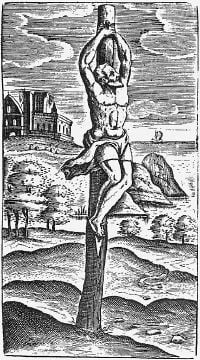
Crux simplex, a unproblematic wooden torture stake, by Justus Lipsius.
Crucifixion was carried out in many ways under the Romans. Josephus describes multiple positions of crucifixion during the siege of Jerusalem in 70 C.Eastward. when Titus crucified the rebels;[10] and Seneca the Younger recounts: "I encounter crosses at that place, non just of one kind merely fabricated in many dissimilar ways: some have their victims with head down to the footing; some impale their private parts; others stretch out their arms on the gibbet."[2]
At times the gibbet was only one vertical stake, called in Latin crux simplex or palus. This was the most basic available construction for crucifying. Frequently, all the same, there was a cross-piece attached either at the top to give the shape of a T (crux commissa) or just below the acme, as in the form most familiar in Christian symbolism (crux immissa). Other forms were in the shape of the letters 10 and Y.
The earliest writings that speak specifically of the shape of the cross on which Jesus died draw it every bit shaped like the alphabetic character T (the Greek alphabetic character tau). Some 2d-century writers took it for granted that a crucified person would accept his artillery stretched out, not connected to a single stake: Lucian speaks of Prometheus equally crucified "above the ravine with his hands outstretched" and explains that the letter of the alphabet T (the Greek alphabetic character tau) was looked upon as an unlucky letter or sign (similar to the way the number 13 is looked upon today every bit an unlucky number), saying that the letter got its "evil significance" because of the "evil instrument" which had that shape, an instrument which tyrants hung men on.[15] Others described it as equanimous of an upright and a transverse beam, together with a small peg in the upright:
The very form of the cross, too, has five extremities, 2 in length, two in breadth, and ane in the middle, on which [last] the person rests who is stock-still by the nails.[16]
The oldest paradigm of a crucifixion was institute past archaeologists more than than a century ago on the Palatine Colina in Rome:
It is a 2nd-century graffiti scratched into a wall that was role of the imperial palace complex. Information technology includes a caption - not by a Christian, but by someone taunting and deriding Christians and the crucifixions they underwent. Information technology shows crude stick-figures of a boy reverencing his "God," who has the head of a jackass and is upon a cross with arms spread wide and with hands nailed to the crossbeam. Here we take a Roman sketch of a Roman crucifixion, and information technology is in the traditional cantankerous shape.[15]
Location of the nails
In popular depictions of crucifixion (possibly derived from a literal reading of the Gospel of John'due south statement that Jesus' wounds were 'in the hands'),[17] the condemned is shown supported only by nails driven direct through the feet and the palms of the hands. This is possible only if the condemned was as well tied to the cantankerous past ropes, or if in that location was a foot-residuum or a sedile to relieve the weight: on their ain, the hands could not back up the full body weight, considering in that location are no structures in the hands to prevent the nails from ripping through the flesh due to the weight of the body.[18]
The scholarly consensus, however, is that the crucified were nailed through the wrists betwixt the ii bones of the forearm (the radius and the ulna) or in a space between four carpal bones rather than in the easily. A human foot-rest attached to the cantankerous, peradventure for the purpose of taking the man'southward weight off the wrists, is sometimes included in representations of the crucifixion of Jesus, but is non mentioned in ancient sources. These, however, do mention the sedile, a small seat attached to the front of the cross, about halfway downward, which could take served that purpose. If the writings of Josephus are taken into account, a sedile was used at times as a way of impaling the "private parts." This would be achieved past resting the condemned man'due south weight on a peg or board of some sort, and driving a nail or spike through the genitals. If this was a common exercise, so it would give brownie to accounts of crucified men taking days to die upon a cantankerous, since the resting of the torso upon a crotch peg or sedile would certainly preclude death by suspension asphyxiation. It would also provide another method of humiliation and great hurting to the condemned.
Cause of death
The length of time required to reach death could range from a affair of hours to a number of days, depending on verbal methods, the health of the crucified person and ecology circumstances.
Pierre Barbet holds that the typical crusade of death was asphyxiation. He conjectured that when the whole body weight was supported past the stretched arms, the condemned would take severe difficulty inhaling, due to hyper-expansion of the lungs. The condemned would therefore have to describe himself up by his arms, or take his anxiety supported by tying or by a wood cake. Indeed, Roman executioners could be asked to break the condemned's legs, subsequently he had hung for some time, in order to hasten his death.[19] In one case deprived of support and unable to lift himself, the condemned would dice within a few minutes. If expiry did non come from asphyxiation, it could issue from a number of other causes, including physical shock caused past the scourging that preceded the crucifixion, the nailing itself, dehydration, and exhaustion.
It was, however, possible to survive crucifixion, and there are records of people who did. The historian Josephus, a Judaean who defected to the Roman side during the Jewish uprising of 66 - 72 C.E., describes finding two of his friends crucified. He begged for and was granted their reprieve; one died, the other recovered. Josephus gives no details of the method or elapsing of crucifixion before their reprieve.
Archaeological evidence
Despite the fact that the ancient Jewish historian Josephus, as well as other sources, refer to the crucifixion of thousands of people by the Romans, in that location is merely a single archaeological discovery of a crucified body dating back to the Roman Empire around the time of Jesus, which was discovered in Jerusalem. Notwithstanding, it is not surprising that at that place is only one such discovery, because a crucified torso was normally left to decay on the cross and therefore would not exist preserved. The simply reason these archaeological remains were preserved was because family members gave this particular private a customary burial.
The remains were constitute accidentally in an ossuary with the crucified man's name on it, 'Yehohanan, the son of Hagakol'. The ossuary contained a heel with a blast driven through its side, indicating that the heels may have been nailed to the sides of the tree (one on the left side, 1 on the right side, and not with both feet together in front). The nail had olive forest on it indicating that he was crucified on a cross made of olivewood or on an olive tree. Since olive trees are not very tall, this would propose that the condemned was crucified at eye level. Additionally, the piece of olive wood was located betwixt the heel and the head of the nail, presumably to go along the condemned from freeing his pes by sliding it over the nail. His legs were establish broken. (This is consistent with accounts of the execution of two thieves in the Gospel of St. John nineteen:31.) It is thought that since in Roman times iron was expensive, the nails were removed from the dead body to cut the costs, which would assistance to explicate why simply one has been found, as the back of the smash was bent in such a way that it could not be removed.
Other Details
Some Christian theologians, start with Saint Paul writing in Galatians iii:13, have interpreted an allusion to crucifixion in Deuteronomy 21:22-23. This reference is to being hanged from a tree, and may exist associated with lynching or traditional hanging. However, ancient Jewish law immune simply 4 methods of execution: stoning, burning, strangulation, and decapitation. Crucifixion was thus forbidden by ancient Jewish police force.[20]
Famous crucifixions
- Jesus of Nazareth, the all-time-known case of crucifixion, was condemned to crucifixion[21](nearly likely in thirty or 33 C.E.) past Pontius Pilate, the Roman governor of Judea. According to the New Testament, this was at the instigation of the Jewish leaders, who were scandalized at his claim to be the Messiah.
- The rebel slaves of the Third Servile State of war: Between 73 B.C.E. and 71 B.C.Eastward. a band of slaves, eventually numbering most 120,000, nether the (at least partial) leadership of Spartacus were in open up defection against the Roman Republic. The rebellion was eventually crushed, and while Spartacus himself almost probable died in the final battle of the defection, approximately 6000 of his followers were crucified forth the 200 km route betwixt Capua and Rome, equally a alert to any other would-be rebels.
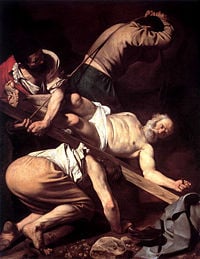
- Saint Peter, Christian apostle: co-ordinate to tradition, Peter was crucified upside downward at his ain request (hence the "Cross of Saint Peter"), as he did non feel worthy to die the same way every bit Jesus (for he had denied him three times previously). Note that upside-down crucifixion would not consequence in death from asphyxiation.
- Saint Andrew, Christian apostle: according to tradition, crucified on an X-shaped cross, hence the name Saint Andrew'due south Cantankerous.
- Simeon of Jerusalem, 2nd Bishop of Jerusalem, crucified either 106 or 107.
- Archbishop Joachim of Nizhny Novgorod: reportedly crucified upside downward, on the Purple Doors of the Cathedral in Sevastopol, Ukrainian SSR in 1920.
- Wilgefortis was venerated as a saint and represented every bit a crucified adult female, yet her legend comes from a misinterpretation of the full-clothed crucifix of Lucca.
Crucifixion in popular culture
Many representations of crucifixion can still be found in popular culture in various mediums including cinema, sports, digital media, anime, and pop music, among others.
Crucifixion-type imagery is employed in several of the pop films, video games, music (and even professional person wrestling!).
Movies dating back to the days of the silent films have depicted the crucifixion of Jesus. Virtually of these follow the traditional (and often inaccurate) blueprint established by medieval and Renaissance artists, though there have been several notable exceptions. In The Passover Plot (1976) the ii thieves are not shown to either side of Jesus but instead ane is on a cross behind and facing him while the other is on a cross in front of and facing abroad from him. Ben-Hur (1959) may be the commencement Biblical movie to testify the nails being driven through the wrists rather than the palms. It is also ane of the first movies to show Jesus carrying just the crossbeam to Calvary rather than the entire cross. The Last Temptation of Christ is the commencement movie to bear witness Jesus naked on the cross. In The Gospel of John (2003), Jesus' feet are shown being nailed through the talocrural joint to each side of the upright portion of the cross. In The Passion of the Christ (2004), the crucifixion scene depicts Jesus'due south hands being impaled, and the centurions dislocating his shoulder in lodge to impale his right hand, and impaling his feet, and so turning the cantankerous over to block the nails from coming out.
Notes
- ↑ Crucifixion Online Etymology Lexicon. Retrieved February 21, 2019,
- ↑ 2.0 2.one Seneca the Younger, (Dialogue "To Marcia on Consolation," half dozen.20.3 The Latin Library. Retrieved February 21, 2019).
- ↑ iii.0 three.1 F.P. Retief and 50. Cilliers, The history and pathology of crucifixion South African Medical Periodical 93(12) (2003):938-941. Retrieved Feb 21, 2019.
- ↑ Damian Barry Smith, The Trauma of the Cross: How the Followers of Jesus Came to Understand the Crucifixion (Mahwah, NJ: Paulist Press, 1999), fourteen.
- ↑ William A. Oldfather, LIVY I.26 and the Supplicum de More Maiorum Transactions of the American Philological Association 39 (1908):49‑72.
- ↑ Apologia, IX, ane Tertulliani Liber Apologeticus. Retrieved Feb 21, 2019.
- ↑ Afterward quoting a verse form by Maecenas that speaks of preferring life to death even when life is burdened with all the disadvantages of old age or fifty-fifty with acute torture ("vel acuta si sedeam cruce"), Seneca disagrees with the sentiment, saying death would be better for a crucified person hanging from the patibulum: "I should deem him most despicable had he wished to alive to the bespeak of crucifixion …. Is it worth so much to counterbalance downwardly upon one'southward ain wound, and hang stretched out from a patibulum? … Is anyone found who, after being fastened to that accursed woods, already weakened, already plain-featured, swelling with ugly weals on shoulders and chest, with many reasons for dying even before getting to the cross, would wish to prolong a life-breath that is nigh to feel and then many torments?" ("Contemptissimum putarem, si vivere vellet usque advertisement crucem … Est tanti vulnus suum premere et patibulo pendere districtum … Invenitur, qui velit adactus ad illud infelix lignum, iam debilis, iam pravus et in foedum scapularum air-conditioning pectoris tuber elisus, cui multae moriendi causae etiam citra crucem fuerant, trahere animam tot tormenta tracturam?" - Seneca the Younger, Alphabetic character 101, 12-xiv The Latin Library. Retrieved February 21, 2019.
- ↑ Tacitus, Annales two:32.ii The Latin Library. Retrieved February 21, 2019.
- ↑ Tacitus, Annales 15:60.1 The Latin Library. Retrieved February 21, 2019.
- ↑ ten.0 x.1 Flavius Josephus, The Jewish War (Penguin Classics, 1984, ISBN 978-0140444209).
- ↑ Mishna, Shabbath half-dozen.10 Retrieved Feb 21, 2019.
- ↑ James Kiefer, The Martyrs of Nihon, February v, 1597. The Lectionary. Retrieved Feb 21, 2019.
- ↑ Larry Rohter, A Mexican Tradition Runs on Pageantry and Faith The New York Times, April 11, 2009. Retrieved Feb 21, 2019.
- ↑ James Deakin, Images of Reenacted Crucifixions from the Philippines. (Warning: Some are graphic.) Retrieved February 21, 2019.
- ↑ 15.0 15.ane Clayton F. Bower, Jr., Cantankerous or Torture Pale? Catholic Answers, October 1, 1991. Retrieved February 21, 2019.
- ↑ Irenaeus, Against Heresies (Book II, Chapter 24)) New Advent. Retrieved February 21, 2019.
- ↑ The Gospel word χείρ (cheir), translated every bit "hand," can include everything below the mid-forearm: Acts 12:7 uses this word to report chains falling off from Peter's 'hands', although the chains would be around what we would call wrists. This shows that the semantic range of χείρ is wider than the English mitt, and tin exist used of nails through the wrist.
- ↑ Cahleen Shrier, The Science of the Crucifixion APU Life, Spring 2002, AZUZA Pacific University. Retrieved February 21, 2019.
- ↑ John 19:31-32
- ↑ See Mishnah, Sanhedrin 7:1, translated in Jacob Neusner, The Mishnah: A New Translation. 591 (1988), supra note 8, at 595-596 (indicating that court ordered execution by stoning, called-for, decapitation, or strangulation only)
- ↑ That this was the style of his death is not merely recounted in the iv get-go-century canonical Gospels, but it is referred to repeatedly, as something well known, in the earlier letters of Saint Paul, for instance five times in his Outset Letter of the alphabet to the Corinthians, written in 57 C.E. (1:13, i:xviii, 1:23, 2:ii, 2:8). Pilate was the Roman governor at the time, and he is explicitly linked with the condemnation of Jesus non but past the Gospels only also by Tacitus, Register', xv.44.
References
ISBN links support NWE through referral fees
- Hengel, Martin. Crucifixion. Augsburg Fortress, 1977. ISBN 080061268X
- Holoube, J.E., and A. B. Holoubek, "Execution past crucifixion." Journal of Medicine 26.
- Neusner, Jacob. The Mishnah: A New Translation. Yale University Printing, 1991. ISBN 978-0300050226
- Smith, Damian Barry. The Trauma of the Cross: How the Followers of Jesus Came to Understand the Crucifixion. Mahwah, NJ: Paulist Press, 1999. ISBN 978-0809139088
- Tzaferis, Vassilios. "Crucifixion—The Archaeological Evidence." Biblical Archeology Review xi (February, 1985): 44–53.
- Zias, Joseph. "The Crucified Man from Giv'at Ha-Mivtar: A Reappraisal." Israel Exploration Journal 35(1) (1985): 22-27.
- This article incorporates text from the Encyclopædia Britannica Eleventh Edition, a publication now in the public domain.
External links
All links retrieved February 21, 2019.
- Jewish Encyclopedia: Crucifixion
- The Martyrs of Japan
Credits
New World Encyclopedia writers and editors rewrote and completed the Wikipedia article in accord with New World Encyclopedia standards. This article abides past terms of the Creative Commons CC-by-sa three.0 License (CC-by-sa), which may be used and disseminated with proper attribution. Credit is due under the terms of this license that can reference both the New World Encyclopedia contributors and the selfless volunteer contributors of the Wikimedia Foundation. To cite this article click here for a list of acceptable citing formats.The history of earlier contributions by wikipedians is accessible to researchers here:
- Crucifixion history
The history of this article since it was imported to New World Encyclopedia:
- History of "Crucifixion"
Note: Some restrictions may apply to utilize of individual images which are separately licensed.
Source: https://www.newworldencyclopedia.org/entry/Crucifixion
0 Response to "what wood did the romans use to crucify"
Post a Comment